8.0% GDP Growth Fuels Vietnam's Tech Manufacturing Leap
"The world's factories are moving, and the new map is being drawn in Southeast Asia."
Vietnam is rapidly transforming from a low-cost assembly hub into a critical node for high-tech manufacturing and semiconductor-related processes. Through strategic investment and a shifting global landscape, the nation is positioning itself to capture a vital piece of the global technology pie.
* Vietnam is successfully attracting massive Foreign Direct investment into high-tech manufacturing sectors. * The country's integration into global supply chains is deepening, mirroring broader shifts in manufacturing globalization. * The growth trajectory of the industrial sector provides a strong foundation for scaling up advanced production capabilities.

Why is Vietnam becoming a magnet for high-tech investment?
At dawn in the bustling port, the salty breeze hits a worker's face as they watch a crane lift heavy steel containers into the morning light.
A shipping container crane groans against the salty air of Hai Phong, moving massive steel boxes that once only held textiles but now carry complex electronic components.
According to the Ministry of Finance, the 2024 Union budget of India proposed a 71% increase in funding to ₹13,104.50 crore for the manufacturing of chips and electronics.
The hum of specialized machinery replaces the clatter of manual looms as specialized industrial parks expand deep into the provinces.
The global manufacturing landscape is undergoing a massive reorganization as companies look to diversify away from traditional hubs to mitigate risk.
Vietnam has emerged as a primary beneficiary of this shift due to its strategic geography, competitive operational costs, and a government increasingly focused on high-tech incentives.
Current investment trends show a move toward specialized assembly, testing, and component manufacturing. While the world once looked to the region for simple consumer goods, the current influx involves sophisticated electronics and specialized hardware.
This transition is not just about finding cheaper labor; it is about finding a stable, scalable environment for complex production lines.
But why is this happening right now, and what does it mean for the chips inside our pockets?

How will semiconductors drive Vietnam's industrial leap? A technician in a cleanroom suit peers through a microscope at a silicon wafer, the tiny components representing the future of global connectivity.
The quiet, temperature-controlled environment of a modern facility stands in starkly different contrast to the bustling streets of Ho Chi Minh City just a few miles away.
The semiconductor market is a massive, multi-hundred-billion-dollar engine that drives the modern economy. According to the Semiconductor Industry Association, global sales of semiconductors reached a record $555.9 billion in 2021, reflecting a growth of 26.2% over the previous year.
In that same year, China's sales reached $192.5 billion, accounting for 35 percent of the global semiconductor market as estimated by the World Semiconductor Trade Statistics (WSTS) and the Semiconductor Industry Association (SIA).
Vietnam is inserting itself into this massive value chain by focusing on the critical stages of assembly, testing, and packaging.
While leaders like Taiwan—with TSMC maintaining an unmatched lead in the industry as of 2020—focus on pure-play wafer fabrication, Vietnam is building the infrastructure to handle the essential late-stage processes.
This specialized focus allows the country to integrate into the broader ecosystem without immediately needing to match the extreme capital requirements of leading-edge chip fabrication.
However, the physical hardware is only one part of the equation; the economic engine requires something much more dynamic.
What can global manufacturing shifts teach us? A dusty ledger from a decades-old factory sits on a wooden desk, documenting the era of manual labor and commodity-driven growth. Outside, the skyline of a modern industrial district rises, built on the capital generated by the transition to automated systems.
Understanding the current shift requires looking at how industrial growth has historically fueled national economies. The relationship between industrial output and the broader economy is often reflected in rapid growth spurts.
For example, according to World Bank data, Vietnam recorded a massive GDP growth of 8.0% in 2025.
This level of growth is characteristic of a nation moving through different stages of industrialization. Historically, growth was driven by labor-intensive sectors, but modern high-tech growth is driven by value-added processes and technological integration.
As the economy moves from raw commodity exports to high-tech components, the complexity of the workforce and the value of the output increase exponentially.
But as the economy scales, the physical and human requirements for growth become much harder to manage.

Building the Future Ecosystem: Infrastructure and Human Capital
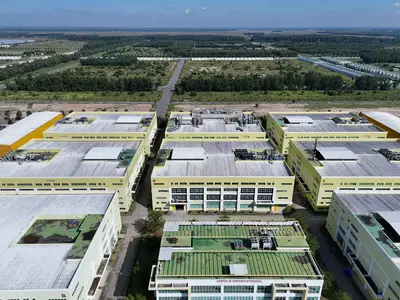
Engineers sit around a sleek conference table in a modern industrial park, reviewing blueprints for a new automated assembly line. The air conditioning is crisp, and the windows overlook a sprawling complex of specialized warehouses and specialized labs.
To sustain high-tech growth, specialized industrial parks must act as more than just plots of land; they must be integrated ecosystems with reliable power, high-speed data, and seamless logistics.
These parks are being designed to house entire supply chains, reducing the friction of moving components between different stages of production.
However, infrastructure alone is insufficient without a skilled local talent pool. The transition to advanced manufacturing requires a workforce capable of operating,s maintaining, and innovating within complex electronic environments.
Investment in domestic education and specialized training programs is becoming as critical as the physical construction of factories. The success of these high-tech lines depends on the ability to scale human capital alongside mechanical capacity.
If the infrastructure is the skeleton, the global supply chain is the nervous system that connects it all.
Navigating Global Supply Chain Realities
A logistics manager stares at a digital map on a wall-mounted screen, tracing shipping routes that span across oceans and continents. The lines on the map represent the delicate balance of global trade and the constant effort to avoid single-point failures.
Geopolitical pressures and the desire for "China Plus One" strategies have forced multinational corporations to diversify their production bases. The goal is to avoid over-reliance on a single country, ensuring that a localized disruption doesn't collapse a global product line.
Vietnam's positioning as a stable, alternative hub makes it an ideal candidate for this diversification.
By building a resilient manufacturing base, Vietnam is helping to stabilize the global supply chain. As companies move specialized processes to different regions, they create a more distributed and robust network.
This shift toward regionalized and diversified production is not just a trend; it is a fundamental restructuring of how the world's most essential components are made.
| Feature | Traditional Manufacturing | Advanced High-Tech Manufacturing |
|---|---|---|
| Primary Driver | Low labor costs | Technological integration & specialized skills |
| s* Infrastructure Needs | Basic transport & power | Reliable, high-spec industrial parks |
| Workforce Focus | Manual assembly | Engineering, testing, & maintenance |
| Supply Chain Role | Commodity-based | Critical component-based |
- Identify Strategic Niches: Focus on specialized sectors like semiconductor assembly and testing to build expertise.
- Develop Specialized Infrastructure: Invest in industrial parks that provide high-spec power and logistics.
- Scale Human Capital: Align educational programs with the needs of high-tech manufacturing.
- Integrate into Global Networks: Use FDI to draw in companies that require deep-tier component manufacturing.
When I first walked through the industrial zones near Bac Ninh, the contrast between the quiet, high-tech cleanrooms and the bustling street markets just outside the gates was striking. It felt like watching two different centuries existing in the same square mile.
FAQ
Q: What is the current global scale of the semiconductor market? A: The market is massive and growing. In list-based historical data, semiconductor sales reached $555.9 billion in 2021, showing a growth of 26.2% over the previous year.
Q: What are the key drivers behind manufacturing investment shifts globally? A: The primary drivers are the need for supply chain resilience, the mitigation of geopolitical risks, and the pursuit of operational efficiency through specialized industrial hubs.
Q: How does Vietnam's industrial growth compare to historical benchmarks? A: Vietnam's growth has been significant, with the World Bank reporting a GDP growth of 8.0% in 2025, reflecting a powerful industrial expansion period.






Comments 0